ModelsPricingEnterprise
500+ AI Model API, All In One API.Just In CometAPI
Models API
Developer
Quick StartDocumentationAPI Dashboard
Company
About usEnterprise
Resources
AI ModelsBlogChangelogSupport
Terms of ServicePrivacy Policy
© 2026 CometAPI · All rights reserved
Home/Models/OpenAI/GPT-5.2
O

GPT-5.2

Input:$1.75/M
Output:$14/M
Context:400,000
Max Output:128,000
GPT-5.2 is a multi-flavored model suite (Instant, Thinking, Pro) engineered for better long-context understanding, stronger coding and tool use, and materially higher performance on professional “knowledge-work” benchmarks.
New
Commercial Use
Playground
Overview
Features
Pricing
API

Basic features (what Claude Sonnet 3.5 gives you)

  • Strong reasoning & instruction following: tuned for multi-step logical tasks and document Q&A.
  • Agent & tool use: built to make robust tool-calls and orchestration for agentic workflows (e.g., tool selection, error correction). Anthropic added a public-beta computer-use capability allowing Claude to interact with a GUI (cursor, clicks, typing) in a “flipbook” view. This is experimental but notable for automating GUI tasks.
  • Strong coding ability: competitive HumanEval / SWE-bench performance (see Benchmarks).
  • Managed safety & privacy controls: Anthropic continues to emphasize safety-first training and safer defaults across Claude models.
  • testalt

Technical details of Claude 3.5 Sonnet

  • Multimodal: handles text + images (vision APIs that accept base64 or URL images), including charts/graphs and visual question answering.
  • Long context: published context window of ~200k tokens for long documents and multi-file analysis.
  • Stronger reasoning & coding than prior mid-tier models: targeted gains on developer-facing benchmarks (see Benchmarks).
  • Tooling / agent support: Messages API supports tool-use patterns (code execution, web-fetch, “computer use” style agents) and structured JSON outputs for robust integrations.
  • Safety-first training approach: built with Anthropic’s Constitutional AI principles and additional classifier/safeguard techniques.

Benchmark performance of Claude 3.5 Sonnet

Benchmarks vary by prompt style, shot count, and exact model snapshot. Below are representative, widely-cited public figures (all sources link to the vendor or public benchmark pages):

  • BIG-Bench-Hard (3-shot CoT / Sonnet reporting): ~93.1% — indicating very strong multi-step reasoning performance on the BIG-Bench-Hard suite as reported in vendor/partner listings.
  • HumanEval (code correctness): ~93–94% (reported top-class HumanEval scores for Sonnet in Anthropic/GitHub Copilot materials). This places Sonnet among the highest performers on standard program-synthesis code tests.
  • SWE-bench (agentic coding / GitHub issue solving, “Verified”): ~49% (Sonnet improved substantially versus prior releases on SWE-bench Verified tasks). Note: SWE-bench focuses on real-world GitHub issue resolution and is sensitive to prompt style and environment/tooling.

Caveats about benchmarks: vendors and third-party evaluators use different prompt templates, shot settings, and evaluation filters. Use these numbers as comparative signals rather than absolute guarantees for specific production tasks.

Limitations & known risks of Claude 3.5 Sonnet

  • Hallucinations / factual errors: Sonnet reduces some failure modes versus older models but still produces incorrect or hallucinated facts, especially on niche or extremely recent facts. Use retrieval/RAG and verification for high-stakes outputs.
  • Experimental features: the computer-use capability was released in public beta and is still error-prone (it observes the screen as a flipbook; short-lived UI events can be missed). Don’t rely on it for safety-critical or tightly timed GUI operations without robust monitoring.
  • Bias & safety guardrails: Sonnet inherits Anthropic’s safety-oriented fine-tuning. That reduces many unsafe outputs but can mean conservative refusals or filtered answers in ambiguous cases.
  • Operational limits: token limits, rate limits, pricing tiers and regional availability vary by platform (Anthropic direct, Bedrock, Vertex AI). Pin versions and review platform quotas before production rollout.

Comparison with gpt 4o and Claude 4

(Comparisons are approximate and depend on exact snapshots; numbers below summarize public comparative claims.)

  • vs GPT-4 / GPT-4o (OpenAI): Sonnet often reports higher scores on multi-step reasoning and code correctness benchmarks (e.g., HumanEval / BIG-Bench variants in vendor materials), while GPT variants remain competitive on math & chain-of-thought tasks and in tooling (and may have different latency/cost trade-offs). Empirical comparisons vary by benchmark.
  • vs Anthropic’s own Opus / Claude 4: Opus / Claude 4 (and later Sonnet snapshots) may outperform Sonnet on the most complex, compute-intensive tasks; Sonnet remains attractive for agentic workflows requiring cost/latency balance.

Recommendation: run short, domain-specific A/B tests (same prompts, pinned model versions) rather than relying only on public leaderboards; real application utility is task-specific.


Representative production use cases

  • Agentic automation: tool orchestration, ticket triage, structured tool calls and automated GUI tasks (with monitoring).
  • Software engineering & code assistance: code generation, transformation, migration, PR summarization, debugging suggestions — Sonnet’s SWE-bench / HumanEval strength makes it a strong choice for coding assistants.
  • Document Q&A & summarization: deeper context understanding for contracts, research reports, and long documents (pair with retrieval).
  • Data extraction from visuals: Sonnet has been used for extracting/understanding chart/table content where platforms permit image inputs.

How to access Claude Sonnet 3.5 API

Step 1: Sign Up for API Key

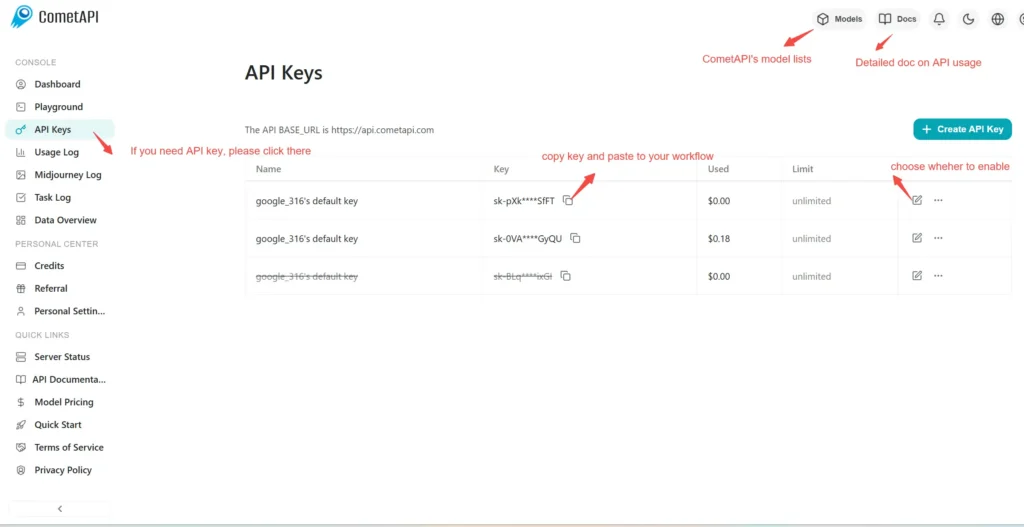
Log in to cometapi.com. If you are not our user yet, please register first. Sign into your CometAPI console. Get the access credential API key of the interface. Click “Add Token” at the API token in the personal center, get the token key: sk-xxxxx and submit.
img

Step 2: Send Requests to Claude Opus 4.1

Select the “claude-3-5-sonnet-20241022” endpoint to send the API request and set the request body. The request method and request body are obtained from our website API doc. Our website also provides Apifox test for your convenience. Replace <YOUR_API_KEY> with your actual CometAPI key from your account. base url is Anthropic Messages format and Chat format.

Insert your question or request into the content field—this is what the model will respond to . Process the API response to get the generated answer.

Step 3: Retrieve and Verify Results

Process the API response to get the generated answer. After processing, the API responds with the task status and output data.

Features for GPT-5.2

Explore the key features of GPT-5.2, designed to enhance performance and usability. Discover how these capabilities can benefit your projects and improve user experience.

Pricing for GPT-5.2

Explore competitive pricing for GPT-5.2, designed to fit various budgets and usage needs. Our flexible plans ensure you only pay for what you use, making it easy to scale as your requirements grow. Discover how GPT-5.2 can enhance your projects while keeping costs manageable.

Doubao Seed 2.0 Series Pricing (USD)

Model NameYour Price (USD / 1M Tokens)Official Price (USD / 1M Tokens)Discount
doubao-seed-2-0-proInput: $0.40 / Output: $2.00Input: $0.44 / Output: $2.2120% OFF
doubao-seed-2-0-codeInput: $0.40 / Output: $2.00Input: $0.44 / Output: $2.2120% OFF
doubao-seed-2-0-liteInput: $0.08 / Output: $0.48Input: $0.083 / Output: $0.5020% OFF
doubao-seed-2-0-miniInput: $0.024 / Output: $0.24Input: $0.028 / Output: $0.2820% OFF

Sample code and API for GPT-5.2

Access comprehensive sample code and API resources for GPT-5.2 to streamline your integration process. Our detailed documentation provides step-by-step guidance, helping you leverage the full potential of GPT-5.2 in your projects.
POST
/v1/chat/completions
POST
/v1/responses
POST
/v1/messages
POST
/v1beta/models/{model}:generateContent
POST
/rerank
POST
/v1/images/generations

More Models

O

GPT-5.2 Chat

O

GPT-5.2 Chat

Input:$1.75/M
Output:$14/M
gpt-5.2-chat-latest is the Chat-optimized snapshot of OpenAI’s GPT-5.2 family (branded in ChatGPT as GPT-5.2 Instant). It is the model for interactive/chat use cases that need a blend of speed, long-context handling, multimodal inputs and reliable conversational behaviour.
O

GPT-5.1 Chat

O

GPT-5.1 Chat

Input:$1.25/M
Output:$10/M
GPT-5.1 Chat is an instruction-tuned conversational language model for general-purpose chat, reasoning, and writing. It supports multi-turn dialogue, summarization, drafting, knowledge-base QA, and lightweight code assistance for in-app assistants, support automation, and workflow copilots. Technical highlights include chat-optimized alignment, controllable and structured outputs, and integration paths for tool invocation and retrieval workflows when available.
O

GPT-5.1

O

GPT-5.1

Input:$1.25/M
Output:$10/M
GPT-5.1 is a general-purpose instruction-tuned language model focused on text generation and reasoning across product workflows. It supports multi-turn dialogue, structured output formatting, and code-oriented tasks such as drafting, refactoring, and explanation. Typical uses include chat assistants, retrieval-augmented QA, data transformation, and agent-style automation with tools or APIs when supported. Technical highlights include text-centric modality, instruction following, JSON-style outputs, and compatibility with function calling in common orchestration frameworks.
G

Gemini 2.5 Flash

G

Gemini 2.5 Flash

Input:$0.3/M
Output:$7/M
Gemini 2.5 Flash is an AI model developed by Google, designed to provide fast and cost-effective solutions for developers, especially for applications requiring enhanced Inference capabilities. According to the Gemini 2.5 Flash preview announcement, the model was released in preview on April 17, 2025, supports Multimodal input, and has a context window of 1 million tokens. This model supports a maximum context length of 65,536 tokens.
G

Gemini 2.5 Pro DeepSearch

G

Gemini 2.5 Pro DeepSearch

Input:$10/M
Output:$80/M
Deep search model, with enhanced deep search and information retrieval capabilities, an ideal choice for complex knowledge integration and analysis.
G

Gemini 2.5 Pro (All)

G

Gemini 2.5 Pro (All)

Input:$1.25/M
Output:$2.5/M
Gemini 2.5 Pro (All) is a multimodal model for text and media understanding, designed for general-purpose assistants and grounded reasoning. It handles instruction following, analytical writing, code comprehension, and image/audio understanding with reliable tool/function calling and RAG-friendly behavior. Typical uses include enterprise chat agents, document and UI analysis, visual question answering, and workflow automation. Technical highlights include unified image‑text‑audio inputs, long-context support, structured JSON output, streaming responses, and system-instruction control.

Related Blog

How to Use Seedgream 4.5 API
Jan 23, 2026
seedream-4-5
doubao-seedream-4-5-251128
test

How to Use Seedgream 4.5 API

Seedream 4.5 is the newest evolution of the Seedream family of text-to-image / image-editing models (developed under Byte/BytePlus research). It’s being rolled out across official BytePlus endpoints and multiple third-party platforms — including integrated access via multi-model gateways such as CometAPI — and brings improved subject consistency, typography/text rendering, and multi-image editing fidelity.
How to Run Mistral 3 Locally
Jan 22, 2026

How to Run Mistral 3 Locally

How to Run Mistral 3 Locally
Jan 1, 2026
qwen3-5
minimax-M2-5
Test-0-1

How to Run Mistral 3 Locally

explains what Mistral 3 is, how it’s built, why you might want to run it locally, and three practical ways to run it on your machine or private server — from the “click-to-run” convenience of Ollama to production GPU serving with vLLM/TGI, to tiny-device CPU inference using GGUF + llama.cpp.
GPT-5.2 is Coming: What it is new? All You Need to Know
Dec 8, 2025
gpt-5-1
gpt-5-2

GPT-5.2 is Coming: What it is new? All You Need to Know

OpenAI’s GPT-5.2 is the name being used in the press and inside industry circles for a near-term upgrade to the GPT-5 family of models that powers ChatGPT and
Kling 2.6 explained: What’s New This Time?
Dec 5, 2025
kling-2-6

Kling 2.6 explained: What’s New This Time?

Kling 2.6 arrived as one of the biggest incremental updates in the fast-moving AI video space: instead of generating silent video and leaving audio to